Functional tests for backend Python
Independent test generation for AI-written code
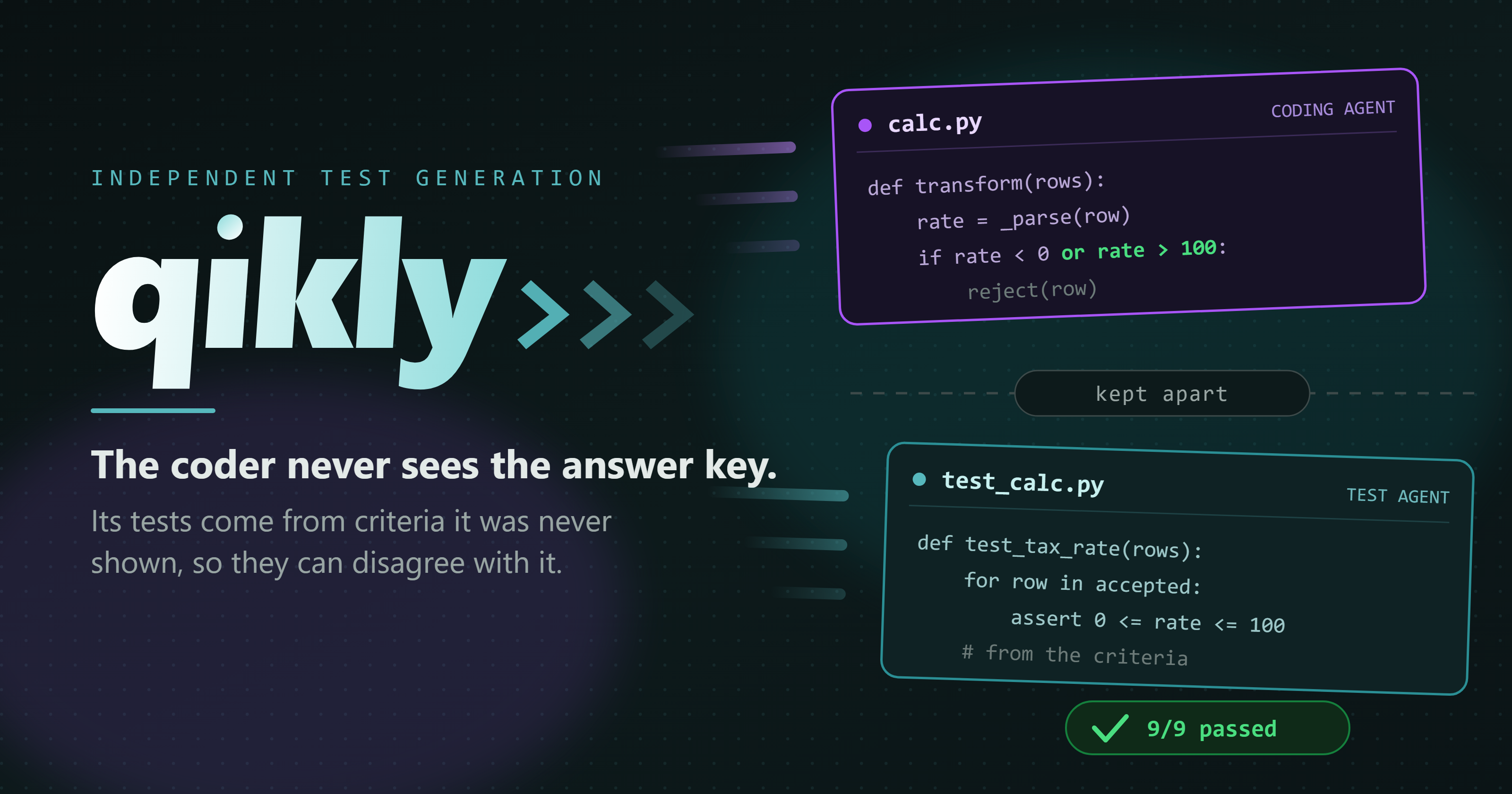
This was run by two independent AI agents:
- The Test Agent builds the test suite: it was told, from the spec's acceptance criteria, that the rate may not exceed 100.
- The Coding Agent never saw the acceptance criteria and
discovered that rate limit from a failing test: it then added
or rate > 100by itself, so the 9 of 9 is code eventually passing the test suite after applying fixes in an automated repair loop.
Start
Create a test suite for your own code
See it work first: qikly --demo runs the
whole loop on a bundled task, nothing to fill in: tests written before any
code, a coding agent that never sees the criteria, and a repair. About
thirty seconds, well under a cent with a Gemini, OpenAI or Anthropic key.
Watch one run
Run these from your project's root folder. Each takes one module or a whole folder, and every step takes the same path.
-
Step 1 Score the tests you have
qikly --score your_module.pyorqikly --score your_project_folderPlants faults in a copy of your code, one at a time, and turns each one your tests did not notice into a question about behaviour nothing checks. Nothing of yours is changed. Where your tests can be
free, no keyWhat it printed for pricing.py, whose two tests both pass [pricing.py] 10 of 13 planted faults missed (77%), 3 caught. [pricing.py] 8 questions your tests leave open, in the same report.
-
Step 2 Answer the questions in the task file
qikly --scaffold your_module.pyorqikly --scaffold your_project_folderWrites the task file,
free, no keyinputs_private/config/tasks/, one per module step 1 asked about for a folder, with everything qikly can read from your code filled in. What is left is step 1's questions, each with what your code does there now, found by running it, numbered, and a line saying what the module is for. Answer each TODO with an option's number, or write your own; a TODO you leave is skipped. This file is the source of truth: change it any time.YOUR_MODULE_VERIFY.yaml qikly --validatewith the same path checks it, free. A module and a folder, answeredThe third question in the file it wrote, answered #? if rate < 0 or rate > 100: #? Your tests never try rate at exactly 100. #? What should apply_discount(100, 100) do? #? 1 = apply_discount(100, 100) returns VALUE #? (as rate 99 does now) #? 2 = apply_discount(100, 100) raises ValueError #? (as rate 101 does now) - 2
qikly runs your code beside the value in question, never at it: the answer is yours
-
Step 3 Get a fresh test suite written from your answers
qikly --tasks your_module.pyorqikly --tasks your_project_folderSet a key first, such as
needs an API keyGEMINI_API_KEY, or one for Anthropic or OpenAI. A test agent writes tests from your answers before any code is shown to it, and a separate coding agent, which never sees them, repairs a copy of your code until they pass. Your files are never edited. Thenqikly --take-testswith the same path copies the new tests into your own tests folder, importing your code, and runs them on it: a test that fails there is one to compare with your answer.The new tests on your own code, and the fix the run made in its copy Run on your own code: 3 failed, 11 passed. These fail on your code and were written from your criteria: test_apply_discount_excessive_rate_raises - if rate < 0 or rate > 100: + if rate < 0 or rate >= 100:
- and + qikly's repair, made in a copy of your code: not your edit
Where your tests can be.
Anywhere in your project, such as a tests/ folder or beside
your code, in files named test_*.py that import your module.
Step 1 finds them; to name them instead, add
--score-tests test_folder/.
Other ways in
qikly --install-skillteaches Claude Code, Gemini CLI, Codex or Cursor to drive qikly
Read more
- Every other way inthe demo, a finished example, and a task written from nothing
- API key setupfor the run: Gemini, OpenAI or Anthropic, and what a wrong key looks like
- Quick startthe same path, command by command
- Design 1: the casewhy an agent that writes its own tests grades its own homework
- Design 2: how well it worksthe measured results
- Design 3: how it is builtthe agents and what each may read
What it is for
The behaviour of backend logic, one module at a time
What a Python module does with its inputs: data transforms and ETL steps, calculations, validation rules, merges and business logic. Integration, system and unit tests, in pytest, for small to mid-sized repositories.
User interfaces, performance, load, security or any other non-functional property, and it does not run end-to-end tests across services.
It fits most naturally where verification already has to be independent of the people who build the thing: Automotive, Medical Devices, Fintech and Defence.
How it works
The coding agent never sees the acceptance criteria
One task file holds the requirements, the interface and the acceptance criteria. The test agent reads all three and writes the integration and system tests before any code exists. The coding agent gets the same file with the criteria cut out, and works from failing tests until the suite passes.
Two obvious objections
"Just use one model for the code and another for the tests."
That helps a little. It does not fix the underlying issue: both models
still read the same criteria, so the code is still built to the standard
it is about to be judged by. Changing who types it does not change
what they were shown. qikly removes the criteria from the coding agent's
prompt, qikly --explain shows the cut, and a test fails the
build if any call site lets a criterion through.
"Doesn't a failing test give the criteria away?" It shows the coding agent that one test, its source and its error, and the test often states the rule it checks. It cannot change a test already written: the integration and system suites exist before any code does, so what the agent learns from a failure can shape the code, never the bar.
See it run end-to-end on a bundled task
One command, about thirty seconds, nothing written outside its folder
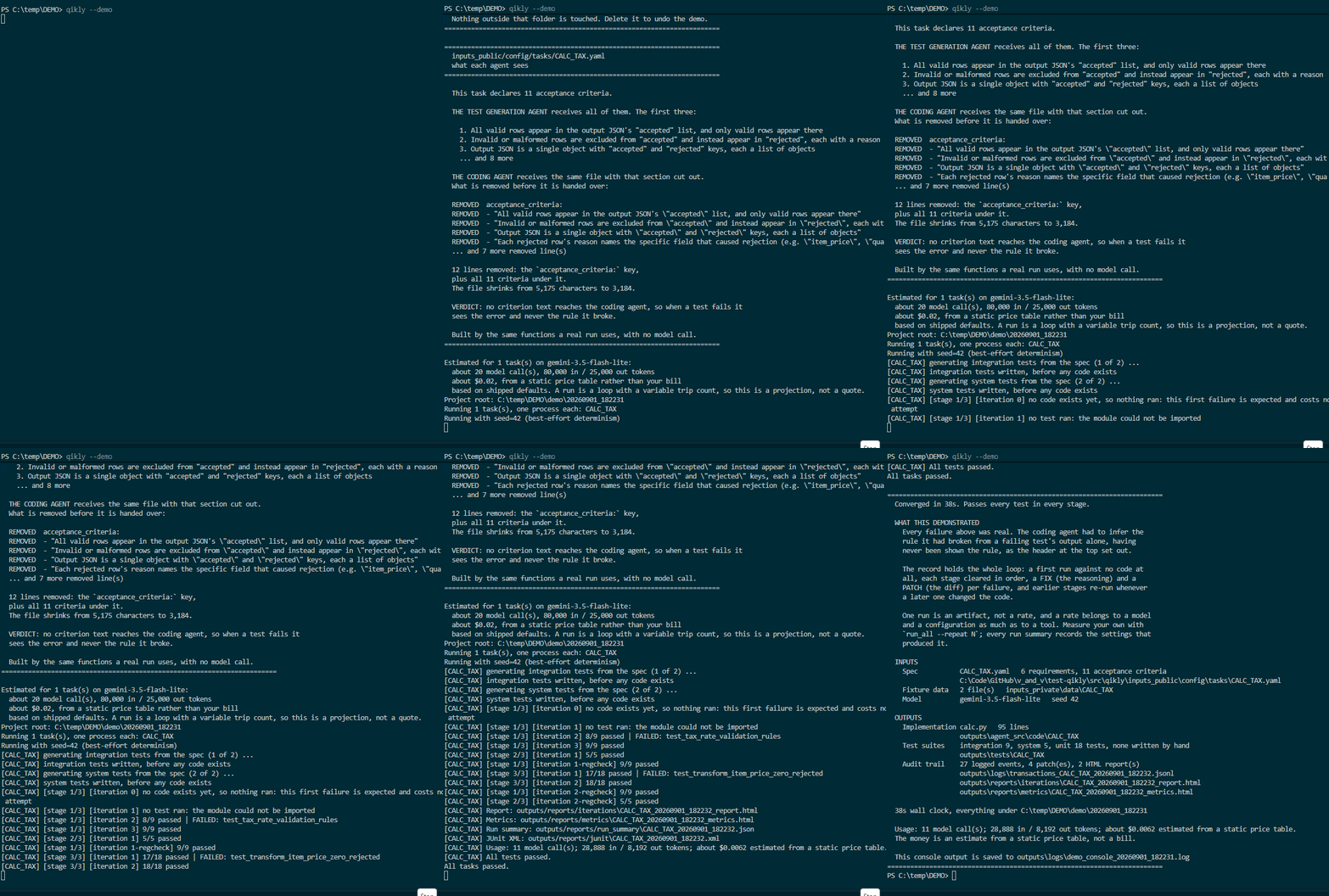
qikly --demo run, unedited. The criteria
are withheld, the suites are generated, a test fails, a patch lands, and
it goes green. 38 seconds on gemini-3.5-flash-lite, not sped up.The separation this tool enforces is ordinary practice in safety-critical engineering, where verification is required to be independent of implementation as part of a V&V (Verification & Validation) methodology for testing. This library's author worked in that setting on General Motors' autonomous vehicle program before building this toolset.